Business Insights
How Often Should You Send Marketing Emails? What One Local Business Learned From Going Weekly

One local business went from sending in bursts to emailing weekly. Revenue per email rose 39%. Here is how often to send marketing emails, with real data.
“How often should you send marketing emails?” is one of the most common questions we hear from business owners. Behind it is usually a worry: send too little and customers forget you, send too much and they unsubscribe.
Most advice online is a rule of thumb. In a Databox survey of 75 marketers, about 45% said they send weekly and about a third send several times a week. Campaign Monitor points to two to three emails a week as the peak.
Those are useful starting points. But what actually happens when a real small business changes how often it sends? Here’s one example from our own client work, with the numbers.
The Business: Already Emailing, Just Not Consistently
Baddhare Salon is a local service business in Myrtle Beach, South Carolina, open since 2017. When Spark Pro Global took over its email and text marketing in 2025, it wasn’t starting from zero. It already had a working email list and some campaigns that made real money.
The problem was consistency. Looking at the history from 2023 to early 2025:
- Frequency swung month to month. Some months had 2 email campaigns. Others had 4 or more.
- Reach jumped around. One newsletter went to about 3,759 people. A later email went to 2,185.
- Every campaign started from scratch. Newsletters, promotions, product offers and event emails went out one at a time, with no rhythm connecting them.
This is the most common pattern we see in small businesses of every kind. The marketing works. It just happens when someone has time.
What Changed: From Campaign-By-Campaign to a Weekly Rhythm
We didn’t add flashy new campaigns. We added structure, built in 4 parts.
1. One weekly anchor email
Every Monday, Baddhare sends a short email showing what’s available that week. It’s simple, useful and easy to act on.
Any business can have its own version. A restaurant can send this week’s specials. A clinic or contractor can share open appointments. A shop can feature new arrivals. A B2B firm can send one practical tip.
2. A monthly newsletter and planned promotions
Around the weekly anchor sit a monthly newsletter and a few seasonal campaigns. The messages lead with the value of an offer instead of relying mainly on discounts.
3. Text messages for urgency
Texts are saved for time-sensitive offers. The pattern that works: a text opens the sale, an email explains it, and a last-call text closes it.
4. Retention emails
Reconnect emails for customers who haven’t been back, referral asks, and the occasional fun interactive email, like a quiz.
The Results: More Emails, More Revenue per Email
Here is the same period, July 1 to November 9, in 2025 and 2026:
| Measure | 2025 | 2026 | Change |
|---|---|---|---|
| Email campaigns sent | 30 | 41 | +11 |
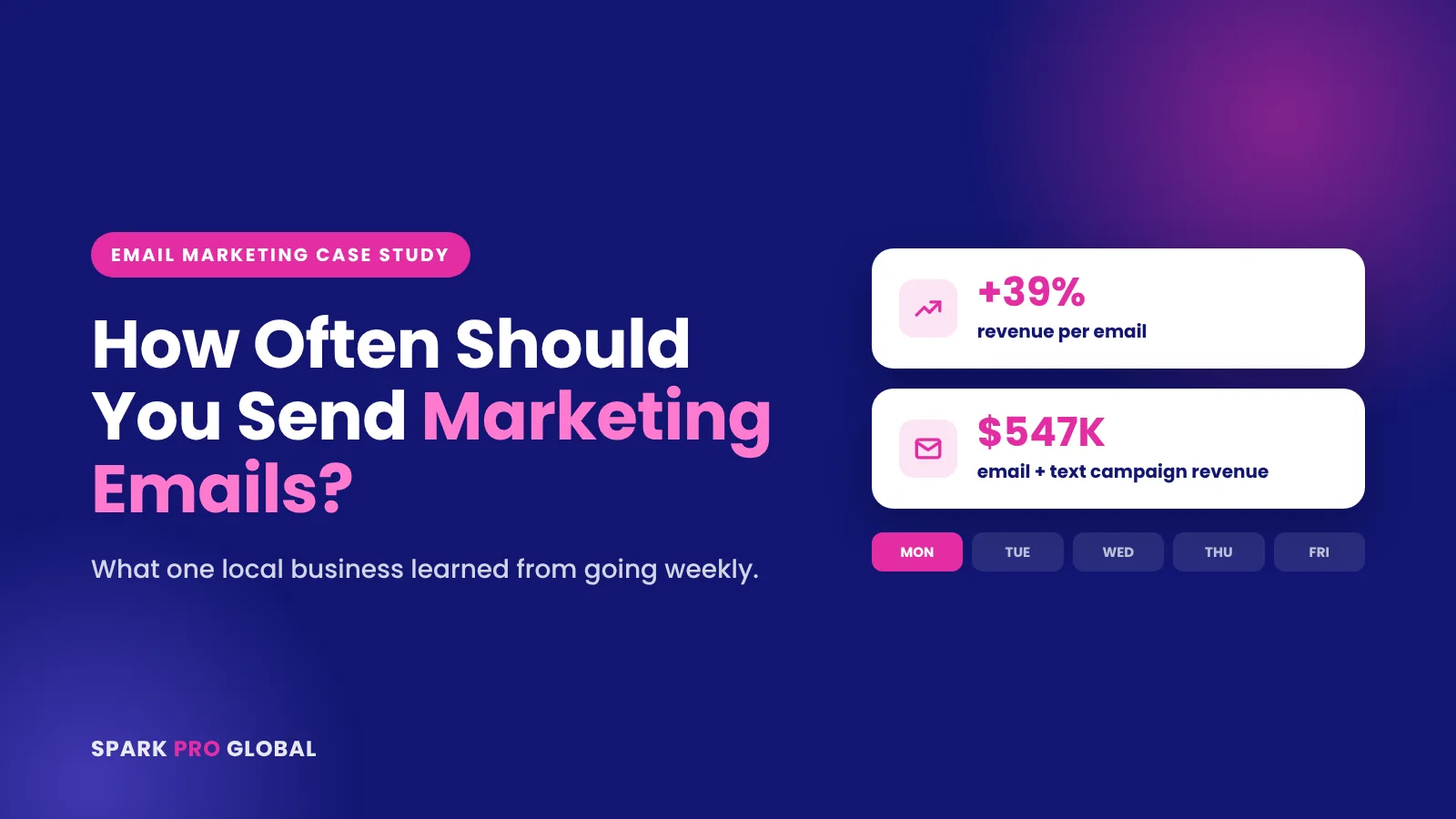
| Revenue per email campaign | $8,981 | $12,458 | +39% |
| Email campaign revenue | $269,437 | $510,771 | +90% |
| Email + text campaign revenue | $547,754 | +53% |
The weekly anchor did the heavy lifting. 18 Monday emails brought in $269,400, more than half of all email revenue. Every full month in the period brought in between $119,000 and $143,000, so revenue became something the business could plan around.
Revenue here is campaign-attributed by the business’s booking software, based on what customers bought after a campaign. It is not total sales, and one customer can count toward more than one campaign.
Will Sending More Emails Annoy Your Customers?
This is the fear behind most “how often” questions. Baddhare’s data gives an honest answer.
The open rate did dip, from 38.4% to 32.2%, as the business sent more emails. But revenue per email rose 39% at the same time. Customers weren’t tuning out. They were acting on emails that were useful.
How many marketing emails is too many? The answer depends less on a number and more on whether each email gives people a reason to open it. A weekly email with something useful in it beats a burst of sales emails followed by silence.
SMS and Email Marketing Work Better Together
Email drove 93% of Baddhare’s campaign revenue. Texts were the extra push. A Halloween flash sale used one email and two texts and earned $28,030, 73% more than the same sale a year earlier. One last-call text earned $8,950 from about 1,950 delivered messages.
The lesson for any business: use email to explain, and text to create urgency. Don’t text for everything.
So, How Often Should You Send Marketing Emails?
Based on the research and this real example, here’s our starting point for most small businesses:
- Send one useful email every week, on the same day. This is your anchor. Never skip it.
- Add a monthly newsletter with news, tips and what’s coming up.
- Plan a few promotions a quarter and support them with texts.
- Track revenue per email, not just open rates. That tells you whether your rhythm is working.
The Hard Part Isn’t the Plan. It’s the Consistency.
Most business owners already know they should email more regularly. The problem is finding the time every single week. That’s why many choose to outsource email marketing to a team that writes, schedules and tracks it for them.
That’s what Spark Pro Global does. Our email marketing campaigns for small businesses take an email list you already have and turn it into a steady rhythm that keeps customers coming back. If your tools are part of the problem, see why the software you already pay for is probably underused. And if you want more new customers finding you in the first place, start with what local SEO is and how it works.
Consistency works the same way on social media. See how a steady posting rhythm helped a nonprofit reach 67.1K views with $0 in ads, or browse more client results on our case studies page.
Frequently Asked Questions
How often should a small business send marketing emails?
Once a week is a strong starting point, as long as every email is useful. Add a monthly newsletter and planned promotions around it.
How many marketing emails is too many?
There’s no single number. Watch unsubscribes and revenue per email. If revenue per email holds or rises as you send more, your audience is still engaged.
How often should you send a newsletter?
Monthly works well for most small businesses, alongside a shorter weekly email.
Should I use SMS and email marketing together?
Yes, for time-sensitive offers. Use email to explain the offer and texts to open and close it.