Business Insights
What Is Local SEO? A Practical Guide for Small Service Businesses

It's the Friday before Memorial Day weekend. A homeowner pulls the cover off her pool and finds green water, a cookout planned for Sunday, and no idea who to call. She grabs her phone and types "pool cleaning near me."…
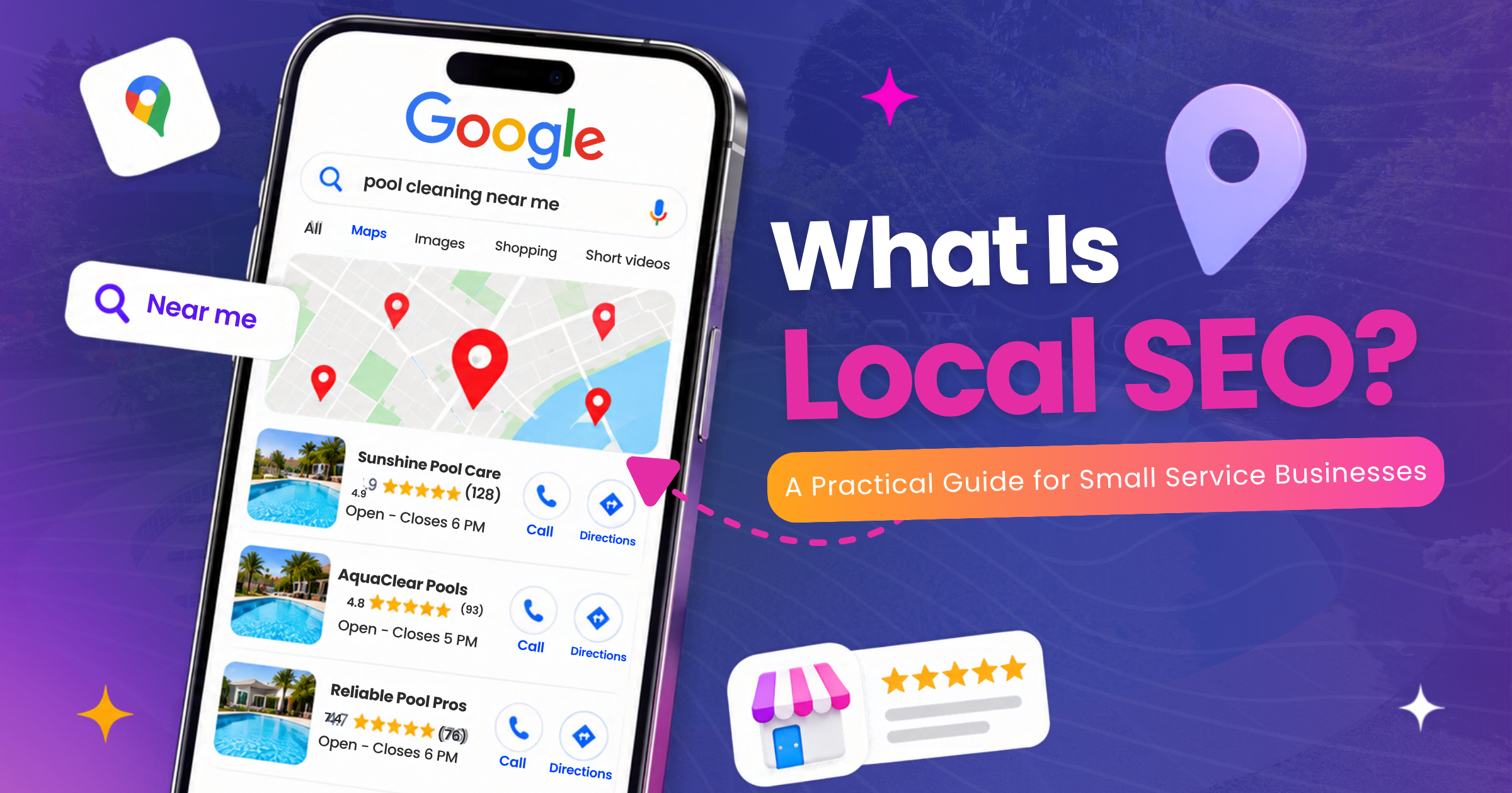
It’s the Friday before Memorial Day weekend. A homeowner pulls the cover off her pool and finds green water, a cookout planned for Sunday, and no idea who to call. She grabs her phone and types “pool cleaning near me.”
Within seconds, Google shows her three local companies on a map. She calls the first one with solid reviews and an open slot. The other pool companies in town never knew she was looking.
So, what is local SEO? It’s the work of helping your business appear in Google Maps, local search results, and AI-generated answers when people nearby search for what you offer. It matters for any business that serves a specific area, whether customers come to you or you go to them.
What Is Local SEO, and How Is It Different From Regular SEO?
Local SEO focuses on searches with a location attached, either stated (“bookkeeper in Tampa”) or implied (“pool cleaning near me”). SEO also covers broader searches that aren’t tied to a specific location, like “how to balance pool chemicals.”
The difference shows up on the results page. Local searches usually trigger the map pack: three business listings with a map, ratings, hours, and buttons to call, get directions, or visit a website. Those listings are built mainly from Google Business Profiles, not from websites alone.
For a small business that serves one town or region, the map pack is often where the calls start. Ranking first nationally for a how-to article is nice. Showing up when a neighbor needs your service this week pays the bills.
How Does Google Rank Businesses in Local Search?
Google weighs three things for local results:
- Relevance — how well your profile and website match the search.
- Distance — how far you are from the searcher or the place named in the search.
- Prominence — how well known your business is, judged by reviews, links, and mentions around the web.
Distance is the one you can’t change, and it explains why a competitor two miles closer to a customer might outrank your business. Relevance and prominence, though, are factors you can improve.
A pool service that lists services like “green pool cleanup” and “salt system repair” and has a steady flow of recent reviews gives Google more useful information about the business than a competitor with a bare profile and outdated reviews.
Does Local SEO Work If Customers Never Visit Your Location?
Yes, for most businesses. Google’s local system covers storefronts, service-area businesses, and professionals who meet clients in person, though each one sets up its profile a little differently.
A pool cleaner who works from home should hide the home address and list the cities or ZIP codes served instead. Consultants are a special case: Google only allows a Business Profile if you meet clients face to face, at your office or theirs.
Fully remote businesses can’t appear in the map pack, so their local SEO leans on the website instead.
| Business type | Examples | How customers find you | Local SEO focus |
| Storefront | Bakery, dental office, retail shop | They visit your address | Accurate address and hours, photos of the location, steady reviews |
| Service-area business | Pool cleaning, HVAC, landscaping, mobile detailing | You travel to them | Hidden home address, defined service area, service pages, photos from real jobs |
| In-person professional services | Accountant, attorney, consultant with an office or on-site visits | Meetings at your office or theirs | Specific categories, credentials, detailed service pages, reviews that describe results |
| Online-only services | Remote consultant, virtual bookkeeper | Video calls and email | No Business Profile; website location pages, local directories, local press and links |
Once you know which setup fits your business, the next step is making sure your Google Business Profile is complete and accurate.
What Does a Google Business Profile Need to Rank Well?
A complete, accurate, and active Google Business Profile is the foundation of local SEO. Plenty of small businesses claim theirs once and never touch it again, which leaves easy ground for competitors who keep theirs current.
- The right primary category. This is one of the strongest signals in the profile. “Pool cleaning service” and “Swimming pool contractor” show up for different searches, so pick the one that matches your main source of revenue.
- Every service you offer. List them individually, with short descriptions. Services like “weekly pool maintenance,” “acid wash,” and “leak detection” help make your profile clearer and more relevant to the searches your customers make.
- A clear service area or address. Storefronts show their address. Service-area businesses hide it and list the cities they cover.
- Real photos of real work. Before-and-after shots of a cleaned-up pool, your branded truck, or your team on site can give potential customers a clearer picture of your business than generic stock images.
- Accurate hours, including holidays. Nothing loses a customer faster than a listing that says “open” and a phone nobody answers.
- Replies to every review. A short, specific response shows prospects that someone is paying attention.
Why Do Service Pages and Location Pages Matter for Local SEO?
Your Google Business Profile helps you appear in local search and Maps, while your website gives Google more detail about your services, locations, and expertise. Your website can also rank in the regular organic results below or alongside the map.
Start with one page per core service. An accounting firm might have separate pages for small business tax prep, bookkeeping, and payroll, each explaining who it’s for, what’s included, and which area the firm serves.
Location pages come next, and this is where many businesses go wrong. Ten pages titled “Pool Cleaning in Mesa” and “Pool Cleaning in Tempe” with only the city name swapped read as thin, duplicate content.
A useful location page covers local specifics: the hard water common in the area, the neighborhoods you service most, a project you finished there, or reviews from customers in that city.
How Do Reviews Affect Local SEO?
Reviews shape both where you rank and whether someone calls. Google factors review count and rating into local results, and customers lean on reviews more every year.
BrightLocal’s 2026 Local Consumer Review Survey found that 41% of consumers now always read reviews when browsing local businesses, up from 29% the year before.
Timing matters more than most owners realize. Ask when the customer is happiest: right after the pool turns clear, after a consultant delivers a plan the client loves, or when an HVAC tech gets the air running again in July. Then send a direct review link by text that same day.
Encourage detail without scripting it. A review that mentions the service and the neighborhood (“they fixed our salt cell in Chandler within a day”) helps future customers far more than “great service.” Google’s policies don’t allow incentives for reviews, so keep the task simple and honest.
If keeping up with review requests and responses becomes difficult, Spark Pro Global’s review management services can help automate and organize that process.
What Local SEO Mistakes Hold Small Businesses Back?
Most local SEO problems come from shortcuts that seem harmless at the time. Here are some common mistakes that can hurt your business’s visibility:
- Stuffing keywords into the business name. Listing yourself as “Blue Wave Pool Cleaning Best Pool Service Phoenix” breaks Google’s guidelines and can get a profile suspended.
- Using a P.O. box or unstaffed virtual office. Google doesn’t accept these as business addresses, and listings built on them tend to get removed.
- Inconsistent contact details. An old phone number on Yelp or a former address on the chamber of commerce site sends mixed signals about who you are.
- Copy-paste city pages. Pages that only swap the city name rarely rank and can weaken how Google views the rest of your site.
- A Facebook page instead of a website. Social profiles help, but they don’t replace service pages that Google can rank.
- Ignoring the profile after setup. Outdated hours, missing services, and unanswered reviews make a business look inactive.
How Long Does Local SEO Take to Show Results?
Some profile updates may affect local visibility within a few weeks, while building stronger visibility through reviews, service pages, and local links can take several months or longer, especially in competitive industries like HVAC or law.
The upside is that local SEO builds on itself. Reviews, service pages, and local links can continue supporting your visibility over time. A paused ad campaign, by contrast, stops generating new paid exposure once it is no longer running.
Where Should a Small Business Start With Local SEO?
Start with your Google Business Profile because it is one of the most important foundations of local search visibility. Confirm your primary category, list your services, set your service area or address, and upload recent photos from real jobs.
Then check that your business name, address, and phone number match everywhere they appear: your website, Yelp, Bing Places, Apple Business Connect, Facebook, and industry directories. After that, build a review request into the moment each job wraps up.
The ongoing work, like writing service pages, updating the profile, answering reviews, and tracking where you rank, is where most owners run out of hours. Spark Pro Global’s local SEO services for small businesses can help handle that recurring work, so you can stay consistent with your local marketing while you focus on customers.
So, what is local SEO? It’s helping your business show up when someone nearby needs exactly what you do, giving them a reason to make that call.
Frequently Asked Questions About Local SEO
What’s the difference between local SEO and Local Services Ads?
Local Services Ads are paid placements that often appear at the very top of results, and you pay per lead rather than per click. They’re available in many home service and professional categories. Local SEO earns unpaid visibility in the map pack and organic results. Many service businesses run both, using ads for immediate calls.
Should I hide my address on Google if I work from home?
Yes, if customers don’t visit you there. Google’s guidelines ask service-area businesses to hide their address and list the areas they serve instead. You can still rank in local results for those areas. Showing a home address that customers can’t visit may confuse people and cause problems with your profile.
How often should I post on my Google Business Profile?
Once a week is a sustainable habit for most small businesses. Google hasn’t confirmed posts as a ranking factor, but they show customers you’re active and give you space to share offers, seasonal reminders, and recent jobs. A pool service might post pool-opening slots every spring and freeze-prep tips each fall.
Do directories like Yelp still matter for local SEO?
Yes, though more for trust than for rankings. Consistent listings on Yelp, Bing Places, Apple Business Connect, and industry directories confirm your details across the web. Customers check several sources too: BrightLocal’s 2026 survey found the average consumer uses six review platforms when choosing a local business. Keep every listing current.
Can a virtual assistant handle local SEO?
A trained virtual assistant can handle most of the recurring work: updating your Business Profile, posting weekly, requesting and replying to reviews, fixing directory listings, and tracking rankings. Strategy, like choosing categories or planning service pages, benefits from an SEO specialist. Many small businesses pair both for steady progress at a manageable cost.